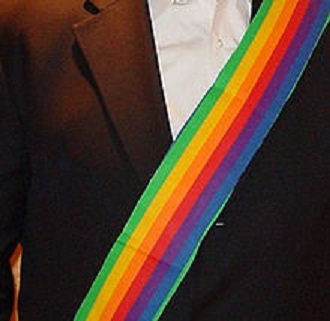
Showing posts with label Catholic Church. Show all posts

Friday, 28 December 2012

Response to Benedict: Dutch Gay Catholics De-Baptize Themselves

Thousands of Dutch Catholics are researching how they can leave the church in protest at its opposition to gay marriage, according to the creator of a website aimed at helping them find the information.


Tom Roes, whose website allows people to download the documents needed to leave the church, said traffic on ontdopen.nl - "de-baptise.nl" - had soared from about 10 visits a day to more than 10,000 after Pope Benedict's latest denunciation of gay marriage this month.


"Of course it's not possible to be 'de-baptized' because a baptism is an event, but this way people can unsubscribe or de-register themselves as Catholics," Roes told Reuters.


He said he did not know how many visitors to the site actually go ahead and leave the church.

- more at Huffington Post


Enhanced by Zemanta

Friday, 14 December 2012

The Rainbow Sash Movement (Lesbian/Gay Catholics) challenges the policy arm of the Catholic Church in Illinois when that Conference makes the claim that it represents nearly 4 million Catholics in the State of Illinois on the issue of Gay Marriage; such a claim is not based in reality.

Rainbow_Sash_Movement_Logo

The Illinois Catholic Conference also states that marriage is unique because it's a union between two genders and "same-sex marriage goes against nature." This is another example of hierarchal bias of basic human rights and fairness for LGBT people. It is not reasonable to deny the evolution of marriage over the centuries with divorce and remarriage being the most obvious example of such evolution.

The Rainbow Sash Movement finds it difficult understand why the Illinois Catholic Conference would align itself with an organization which is part of the ex-gay movement to promote their anti-gay agenda. Courage was founded by Fr. John Harveybased on the 12 step program of Alcoholics Anonymous, and understands sexual orientation of the LGBT Community as a disease to be cured. The attempt to promote such bigotry under their conference is in our opinion not only offensive to the LGBT Community and most reasonable people, but is also lacking in any significant pastoral intent.

The promotion of such ideas by the Illinois Catholic Conference that love is an abomination when Lesbian and Gay couples practice it in Gay Marriage has its origins in ancient taboos, not nature. This only highlights how out of touch Catholic leaders are with the views of pew-sitting Catholics when it comes to Gay Marriage.

At issue is how to balance competing rights—to freedom of religious expression and freedom from discrimination on the basis of sexual orientation. We believe it would be unfortunate to replace legal oppression of one community (LGBT couples) with legal oppression of another (Illinois Catholic Conference), and current Gay Marriage legislation to be introduced in January 2013 has built in protections to make sure this does not happen.

We want to remind our leaders the principles of our faith and church are based on: forgiveness, love, mercy and charity. Not the flawed opinions of men - even those in the church hierarchy. We are calling on our Bishops to refocus their attention on caring for the poor and vulnerable

The Rainbow Sash Movement believes that the Catholic Conference of Illinois has a right to create its own definition of the sacrament of marriage, but not to impose those beliefs on the people of Illinois who understand this as a question of basic fairness and social justice.

Perhaps it is time for the Church to remove itself from Civil Marriage if it cannot tolerate marriage equality which is defined by the state, and focus rather on sacramental marriage which is defined by the Church. The Catholic Conference of Illinois is stepping over the line when it tells non Catholic Churches who they can and cannot marry.

It is time to pass Gay Marriage in Illinois.
SOURCE Rainbow Sash Movement
Enhanced by Zemanta

Thursday, 23 February 2012

Gay Marriage, and the English Catholic Church: More Sanity From Vincent Nichols

Archbishop Vincent Nichols has once again demonstrated sanity and moderation on the place of the Catholic Church in modern society. While there are many loud, outraged voices raised in complaint in the US and in the UK over alleged assaults on religious freedom and of perceived persecution of Christians, Nichols has correctly pointed out that what is happening is not the "persecution" of Christians, but an attempt to separate the legal and cultural life of the country from its Christian roots. He is saying in other words, that what is happening is a removal from the Church of its previously privileged position. This may be deplorable, unfortunate, or welcome - but does not amount to persecution, any more than the removal of apartheid in South Africa represented the persecution of Whites.

The origins of complaints of persecution in the UK are in a series of high profile court judgements which have consistently found that religious freedom does not give Christians the right to contravene anti-discrimination laws. Recently, the volume has stepped up with complaints against the proposed introduction of marriage equality. (A former Anglican Archbishop of Canterbury, Lord Carey, has launched an on-line petition drive in opposition to gay marriage). Archbishop Nichols says that the Catholic Church in England and Wales is against the proposals - but will leave actual opposition to individual Catholics as individuals, but the Church "as a whole" will not join in the campaign.


After a fortnight which has seen the emergence of a "Christianist" backlash – most recently in evidence with an internet petition against gay marriage spearheaded by Lord Carey, the former archbishop of Canterbury – Nichols seems to be supporting the movement from a careful distance.

Catholics will be encouraged to sign the petition against gay marriage as individuals, but the church as a whole will not be part of Carey's campaign even though it opposes a change in the law.

Thursday, 16 February 2012

Catholic Chaplain: “In this Bethlehem, there’s always room for everyone in the inn.”

It may be rare to encounter a multicolored gay pride flag upon entering a church. But Brandeis’ Catholic chaplain, the Rev. Walter Cuenin, proudly displays the rainbow flag in the Bethlehem Chapel’s foyer. With the word “Peace” written across the middle, the flag symbolizes a proclamation of acceptance and unity for each person who may walk through the Bethlehem Chapel’s doors.

Cuenin bases his decision to exhibit a gay pride flag on a tale about Jesus’ birth in Bethlehem. According to Christian tradition, when Mary and Joseph arrived at a Bethlehem inn, Mary was forced to have her baby in an outside stable since there were no rooms left at the inn. Cuenin connects this story to Brandeis’ Bethlehem Chapel by using the multicolored flag to portray that “in this Bethlehem, there’s always room for everyone in the inn.”

Cuenin is currently an ally of Brandeis’ LGBT group, Triskelion. He claims that while the Catholic Church does not support gay marriage, it does welcome gay people to its churches. In fact, when he was a pastor for a larger church nearby, Cuenin had even performed a baptism for the baby of a gay couple.

“The Catholic Church opposes gay marriage, so I cannot directly say I support it, but I have seen from my experience that for many people it creates a much healthier environment … For example, if you were to go to Provincetown in the summer time, where a lot of gay people go, it’s a radically different place today than it was 20 years ago,” Cuenin said. “They are there with children and married, raising kids, so they go home at night. In other words, it has transformed the whole gay scene … it hasn’t led to total debauchery. In some ways, it has pulled people back together,” Cuenin said.

via The Brandeis Hoot .

Enhanced by Zemanta

Wednesday, 15 February 2012

"A Catholic Case for Same-sex Marriage": Gramick, DeBernardo

This month in Maryland and the state of Washington, an extraordinary dynamic is playing itself out:  Two Catholic governors are prodding legislators to pass bills legalizing same-gender marriage. Like Govs. Andrew Cuomo in New York and Pat Quinn in Illinois — whose states recently legalized same-sex civil unions — Govs. Martin O’Malley and Christine Gregoire are acting against the strongly expressed opposition of their church’s bishops.

As Catholics who are involved in lesbian and gay ministry and outreach, we are aware that many people, some of them Catholics, believe that Catholics cannot faithfully disobey the public policies of the church’s hierarchy. But this is not the case.

The Catholic Church is not a democracy, but neither is it a dictatorship. Ideally, our bishops should strive to proclaim the sensus fidelium , the faith as it is understood by the whole church. At the moment, however, the bishops and the majority of the church are at odds. A survey published in September by the Public Religion Research Institute found that 52 percent of Catholics support marriage equality and 69 percent support civil unions.

Those numbers shouldn’t surprise people who are familiar with the Catholic theological tradition. For example, Catholic thinking dictates that we should use the evidence we find in the natural world to help us reach our conclusions. Many Catholics have reflected on the scientific evidence that homosexuality is a natural variant in human sexuality, and understand that lesbian and gay love is as natural as heterosexual love.

 -full reflection at  The Washington Post.

Enhanced by Zemanta

Friday, 10 February 2012

Soho Masses - Supporting Church Teaching.

The Sunday after London Pride last year, our Soho Mass was briefly disturbed by an uninvited visitor, making an entirely unauthorized video recording of the proceedings. His recording of the bidding prayers has now surfaced on some conservative Catholic blogs.

In a Catholic Herald report, some of the bloggers and others opposed to the Masses have used these as supposed evidence that they exist primarily to challenge Church teaching. Fr Ray Blake, for instance, claims that


"What I find scandalous is that Mass is offered for a group of people who, as this video shows, obviously dissent from the teaching of the Church and gather primarily to challenge that teaching, rather than to worship."

This conclusion is patently ridiculous, and not supported by the texts of the bidding prayers themselves. These in particular, appear to be what they most object to:


 .....that the various communities we represent, ethnicity, language, gender and sexual orientations, find means to celebrate this diversity, and strive for greater social justice for all people.

Are the opponents seriously suggesting that we should not be praying for social justice? Another prayer they objected to, was for


...lesbian and gay, bisexual and transgender organisations here and throughout the world, and especially those which gather to support people of faith, that they may reflect the rainbow covenant of justice and integrity which God establishes amongst us.

What is forbidden by Church teaching, is same-sex genital activity. There is nothing in the prayers that even remotely encourages this.

Watch, and decide for yourselves:

What these prayers do promote, is an obvious corollary to the other part of Catechism teaching - the importance of respect, compassion and sensitivity, which must lead to the acceptance of full inclusion of LGBT persons in the Church. So these bidding prayers are promoting, not contradicting, Church teaching - one of the parts that the objectors conveniently ignore. (The other part they ignore, is that none of us has the right to pass judgement on the state of another's soul).

Fr Blake is also totally wrong that the "purpose" of the Mass is not worship. Five years ago, when I and a group of others were discussing with diocesan representatives the parameters for our move into a Catholic parish church, it was clearly understood, and agreed by us, that the Masses were to be pastoral in nature, and not campaigning. As part of the organising team ever since, I can confirm that we have stood by that agreement scrupulously. The sole purpose of the Mass is to provide an opportunity for LGBT Catholics, their families and friends, to meet together for a corporate act of worship, in a setting where they know they will receive a particular welcome - together with other Catholics, and in a parish setting. It is true that I and some of the other organisers do disagree, strongly and publicly, with Vatican doctrine on sexual ethics, but that is kept strictly separate from the conduct of the Masses. (In the same way, it is likely that in any student chaplaincy, there will be a strong proportion of young people who disagree strongly with church teaching on sex before marriage, or on masturbation, but that does not imply that Masses for students are organised to promote dissent. A similar argument applies to family Masses and contraception.)

In his response to the objections, the CH quotes our chairman, Joe Stanley, who said that he did not think Fr Finigan's view of the Soho Masses was representative.


"Our experience of ordinary Catholics in the pew is very different from the comments in the blogosphere. The Masses keep getting represented as "gay Masses"," he said, emphasising that they are public Masses that extend a particular welcome to gay people and their parents, families and friends. 

But the most important response is that of Archbishop Vincent Nichols of the diocese of Westminster, in which the parish falls. In a supportive statement, he reminds us that


As with every Catholic Mass, the bidding prayers celebrated at the parish of Our Lady of the Assumption and St Gregory ask for the intercession of God in the lives of people who may be in need.

Bidding prayers for every Mass must reflect the teaching of the Catholic Church and this applies to the Mass held every fortnight where a particular welcome is extended to lesbian, gay, bisexual, transgendered Catholics and their families. 

There is no sacrilege in bringing together a group of Catholics for worship. The only sacrilege here is in making an unauthorized recording of that worship for the sole purpose of sowing dissension. There is no dissent expressed in praying that all may be included and treated with respect in the Catholic Church. The only dissent, is in opposing a considered, deliberate pastoral plan by the Archdiocese to put Catholic teaching on respect, compassion and sensitivity into practice.


Enhanced by Zemanta

Thursday, 9 February 2012

Catholic Bishops, Gay Marriage - and Slavery.

At Enlightened Catholicism, Colleen has a post  on the Prop 8 ruling and Catholic reaction which used an entirely appropriate picture to illustrate the response of the Catholic bishops:

Catholic orthodoxy teaches that the bishops are their to lead the church. The language we use is filled with the imagery of the shepherd, directly and indirectly, as in "pastor", "pastoral" work, and "flock" and the bishops crook is derived from the shepherd's. In practice however, on the big issues in secular life, far too often it is the bishops who follow the people, and not the other way around. John Boswell showed this clearly for same - sex relationships, showing how the changing degree of official hostility following changing levels of public intolerance,for homosexuals, Jews and gypsies alike. The same is true of other areas where the church has changed it's teaching.

From my own experience, I know that was certainly true in South Africa. The Catholic Church came to play an important and honourable part in campaigning for an end to apartheid, and in easing the path to transition. Some bishops were prominent voices speaking up for justice (notably Archbishop Denis Hurley of Durban), but the Bishops' Conference collectively did not lead the Church in the campaign - they responded, quite late, to intense pressure from ordinary (Black) Catholics. Opening up Catholic schools to all races was an important early move in the destruction of social segregation, but that was not initiated by the bishops. That came from the religious sisters who ran the schools, acting in defiance of secular law and the bishops' timidity.

Going back further in history, slavery is another area where the leadership of the Catholic Church for many years was complicit in slavery and the slave trade, and did not condemn it unambiguously until secular opinion had turned firmly against it. A passing reference to the Church and slavery in the comments thread at a National Catholic Reporter post on the Prop 8 decision, brought this response, from  Joseph Jaglowicz:

Wednesday, 8 February 2012

Religion and Gay Marriage: Reactions to Prop 8 Ruling.

[caption id="attachment_21905" align="aligncenter" width="254" caption="Proposition 8 election map"][/caption]

Catholic bishops have been quick to react to yesterday's court ruling that California's Proposition 8 ballot was unconstitutional, speaking of their disappointment at what they see as the "injustice" of the ruling (an ironic choice of words, as it is the business of the courts above all, to deliberate and rule on matters of justice.  The learned judges in this case, confirming earlier decisions by lower courts, have found that the "injustice" lay in creating two classes of persons, one with lesser rights than the other). Frances De Bernardo at New Ways / Bondings 2.0, recalling the active role that the bishops played in perpetrating the original injustice, reflects on the harm that has done to the Catholic Church in California, and draws an important lesson from it: the urgent need, going forward, to move from a political stance on the matter to a pastoral one:


Though this case temporarily provides a victory for the marriage equality movement in California, there is still work of reconciliation work to be done in the Catholic Church there.  In a post two weeks ago, I mentioned that a California friend told me that the hierarchy’s heavily funded campaign to pass Proposition 8 has had a harmful effect on the pastoral life of LGBT Catholics and their allies in California.  Many have become alienated from the church and left it because of the vociferous anti-gay nature of the campaign and its rhetoric.  While the hierarchy has been focused on the political nature of the marriage debate, it’s time that they started to look at the pastoral component of it, too, and begin the much needed work of reconciliation–for the good of the entire church.

Francis DeBernardo, Bondings 2.0


Other denominations that were active in the Prop 8 campaign against marriage, have expressed similar and predictable disappointment. I am more interested though, in the mounting evidence of an opposite, supportive view from faith leaders.

Tuesday, 7 February 2012

Remembering Fr. Howard Hall, Pioneer of Catholic LGBT Ministry

From a personal recollection by Francis DeBernardo, of New Ways Ministry:


Father Howard Hall, one of the pioneers of LGBT ministry in the Catholic church, has passed away from pancreatic cancer.  Fr. Hall was instrumental in developing diocesan ministry to LGBT people in Baton Rouge, Louisiana, and he was involved in the work of so many of the national Catholic organizations that work for justice and equality for LGBT people:  Catholic Association for Lesbian and Gay Ministry, New Ways Ministry, Fortunate Families, and Dignity.

I had the pleasure of meeting Howard on several occasions over the years, and he was always a gentle and joy-filled presence.  My greatest memory of him comes from the summer of 2000 when I spent two weeks doing New Ways Ministry workshops in Louisiana, Mississippi, and Alabama.  Howard was instrumental in helping us set up and promote the workshop I conducted in his hometown of Baton Rouge.  It is a testimony to the great groundwork that he did there that this workshop was one of the best attended that I have conducted in 18 years of this ministry.

Like many people, I will remember Howard for his great kindness and generosity.  While I was planning that trip to the Gulf Coast, Howard realized that it would be a grueling schedule for me, as I spent each day traveling and doing a program for almost two weeks straight.  To alleviate the stress, Howard offered me use of his small cabin in the countryside not far from Baton Rouge for two days of solitude and silence.  It was a modest, cozy place, and I’ll never forget the peace that I experienced there or the generosity of the priest who provided it.

via   Bondings 2.0.

Even today, it is extremely difficult for a gay priest to come out to more than a few close friends - and even that is not easy. It is even more difficult for those working in parish ministry, and outside a supportive religious order. Yet, it is striking in Father Hall's story, that as a parish priest, he began reaching out to gay and lesbian parishioners as long ago as the early '70's, some forty years ago, and in 1973 launched one of the first Dignity chapters, based in his Baton Rouge parish. He has also worked extensively in LGBT ministry with other organizations, such as New Ways, CALGM, Fortunate Families, and PFLAG.

There is still a long, long way to go on the path to full inclusion for queer Catholics, but we have come a long way already, from the dark days when "gay Catholic" was simply assumed to be an impossible oxymoron. Today, we have widespread acceptance by ordinary Catholics in the pews, who believe that homosexuality is simply not a matter of morality, recognition by many professional moral theologians that official teaching needs a drastic overhaul, and a shift in emphasis by many bishops from the Catechism prohibition on "homosexual acts", to the accompanying Catechism inistence on "dignity, compassion and respect".

This shift over the last half century would not have been possible without the brave work of the early pioneers - like Fr Howard Hall.

(For more extensive biographical information, see his profile on the LGBT Religious Archives Network.)


Related Books:

Arpin, Robert L:  Wonderfully, Fearfully Made: Letters on Living With Hope, Teaching Understanding, And Ministering With Love, from a Gay Catholic Priest With AIDS

McNeill, John:  Both Feet Firmly Planted in Midair

McGinley, Dugan: Acts of Faith, Acts of Love: Gay Catholic Autobiographies as Sacred Texts

Murray, Paul: Life in Paradox: The Story of a Gay Catholic Priest

Stuart, Elisabeth: Chosen: Gay Catholic Priests Tell Their Stories

 Wagner, Richard: Secrecy, Sophistry and Gay Sex In The Catholic Church: The Systematic Destruction of an Oblate Priest


Related articles

Enhanced by Zemanta

Towards Full GLBT Inclusion in Faith: Some Signs of the Times.

Progress towards full queer inclusion in church has been remarkable in some Christian denominations, and familiar enough for the US Mainline Protestant churches, and also in the European Lutheran churches. In the former, the chief marker of progress has been the steady dismantling of barriers to ordination and ministry for openly gay or lesbian clergy, even in non-celibate partnerships, as long as these are committed, faithful and publicly accountable, in a manner comparable to conventional marriage. In Scandinavia, the marker is even more dramatic - the expansion of same  - sex church weddings (already available in Sweden and Iceland, coming to Denmark this years, and probably to Finland next year).

Progress in other denominations and faith traditions has been less visible, but is also very real. As illustration, I offer three stories I have come across over the past 24 hours, representing three very different contexts.


Remembering Joseph Colombo - openly gay theology professor at a Catholic university.

Tomorrow, February 10th, San Diego University will hold a "memorial" for Joseph Colombo, who passed away on January 2nd this year. An obituary in Vista, the college newspaper, says of him

"He was really one of the leading figures in the department," Nelson said, "not only in terms of his excellence in teaching and the hours he gave to advising his students, but in terms of thinking about the direction of the department and mentoring young faculty. It's a huge loss to the department in terms of an elder figure who really was a guiding light for us all."

Colombo actively served the LGBT community both at USD and throughout San Diego. He served as the chair of the board of directors at the San Diego LGBT Center from 1991-1995 and served as the advisor of PRIDE on campus. He was the first openly gay chair of a theology and religious studies department at a Roman Catholic University in the United States.

"He was a pioneer here in that as an openly gay faculty member, he paved the way for every queer student, every queer faculty member, that we can be out at USD," theology and religious studies professor Evelyn Kirkley said. "He really was a great mentor, role model and friend."

There was a time when Catholic church leaders discouraged, or even prohibited, laymen and women from even reading scripture. Those days have long passed, but it is not that long ago that only priests (not even religious sisters) were expected to study formal theology. Nowadays, there are more lay people than clergy studying theology - and many of them have gone on to teach it. A fair proportion of those will be gay, lesbian or trans, just as in the wider community. As they take their places in theology departments, Catholic and other, and contribute to academic research and publication, it is becoming increasingly untenable for the traditional, clerical theologians to simply ignore the queer perspective on their field.


Openly gay chaplain at Evangelical college.

At "Bible - thumping Liberal", Ron Goetz observes that
"Being out on an EFCU campus (Evangelical/ Fundamentalist College/University) used to be impossible. Even today it is barely tolerated, if is tolerated at all" 

but goes on to publish some of the story of Doug Johnson, who was a fellow student with him at Simpson College (now University), a  denominational school of the Christian and Missionary Alliance in California.  After his time at Simpson, Johnson went on to a mid-Western Baptist seminary, and now works as a hospital chaplain.


Then I went back to a Baptist Seminary in the midwest and started to come out.  That is also where I had my first sexual encounter, in the dorm of the Baptist Seminary. Eventually I came to the place of full acceptance, but it was a journey, especially in the institutional church where in the 80′s homosexuality was viewed as anything from some kind of heinous crime against nature to an embarrassment which could screw up one’s chances to fulfill one’s calling as a minister.

Thankfully, that is gradually changing. I am still single, but not because I think of that as more “Christian.” I am single because I haven’t met the right guy yet. I hope it happens someday.

Collectively, Evangelical Christians are known as the major faith group most closely opposed to recognition and acceptance of LGBT relationships or civil rights, but even here, there is change, far more than most people recognize. Research evidence shows that younger evangelicals, especially the millenial generation, have very different concerns to their elders, and a substantial minority do not share their strong opposition to homosexuality and same - sex relationships, or to marriage and family equality. Some are actively promoting lgbt inclusion in their writing (Jay Bakker) or advocacy (Kathy Baldock), and evangelical scholars have produced some good LGBT  - supportive books on scripture. Like  Doug Johnson, there are more pastors who have found ways to serve openly. There are Baptist counterparts to the Catholic organisations Dignity and Quest: The Association of Welcoming and Affirming Baptists in the US, and Affirming Baptists in the UK. Some Baptists, as in all other denominations, are actively promoting marriage equality. (In South Carolina, lesbian pastor Nancy Petty at Pullen Memorial Baptist Church is refusing to sign marriage licences for any couples - until she can legally do so for all).


Orthodox Jewish gay wedding

Finally, just in case anyone imagines that progress to inclusion is limited to European and North American Christian groups, it is not. Change has if anything been swifter among Jews, and is beginning to stir also in Islamic groups, and in some African countries. I'm not going to give examples for all of these, but here's one remarkable example from Orthodox Jewry:

[caption id="attachment_21881" align="aligncenter" width="300" caption="Jewish gay wedding, Rabbi Steven Greenberg presiding"][/caption]

Yasher Koach to chatanim (חתנים or grooms) Yoni Bock and Ron Kaplan!

Standing in matching kittle’s (קיטלנים or traditionally white linen robes that Ashkenazim are known to be buried in after wearing it to their wedding as well as annually on Yom Kippur to signify purity, holiness and new beginnings) and orange kippah’s (כִּפוֹת or platter-shaped head caps worn for respect) the two men stood under the chupah (a symbol of the home that the couple will build together) in Washington D.C. holding hands.

- Lisa Finkelstein

(Presiding at this wedding was Rabbi Steven Greenberg, author of the groundbreaking study of homosexuality in Judaism, "Wrestling with God and Men").

Related Posts:

Baptist Church Embraces Lesbian Minister
Enhanced by Zemanta

Saturday, 28 January 2012

“He Who Pays the Piper” Corollary: the Lesson From Maine

What happens when the piper disregards the adage, and ignores those who pay him?

Bart's post yesterday ("He who pays the piper") reminded me of Frances De Bernardo's report at Bondings 2.0, on how the diocese of Maine is a stark reminder of this. Back in 2oo9, the Bishop of Portland and his allies threw themselves into the battle to repeal the state's gay - marriage law (and no, it wasn't on the side of the traditional Catholic values justice and equality, or protecting all families).


Catholic Church Doesn’t Need to Take Another Battering’

The Catholic hierarchy’s opposition to marriage equality during Maine’s 2009 referendum has had a “devastating” effect on the church there.

That’s the opinion of a Maine parish administrator, and also of William H. Slavick, who penned an op-ed in the Portland Press Herald entitled, "The Maine Catholic Church doesn't need to take another battering."   Slavick, a veteran church reformer and peace activist who ran for U.S. Senate in 2006, points out that the hierarchy’s supposed “victory” has been a decisive defeat on the pastoral level, with financial consequences, too:

“Recently, a parish cluster administrator acknowledged that the referendum repeal campaign was, for the church in Maine, ‘devastating.’ No explanation was necessary. We know. The lack of charity occasioned wide discomfort. Some left, often among the better educated and more generous. More stopped attending Mass after weeks of campaign bullying. With $200,000 of diocesan referendum contributions unexplained, many refused to make contributions from which the bishop received a cut. That includes the Sunday offertory collection.”

Slavick’s concern is timely because  supporters of marriage equality have gathered enough signatures to stage another referendum on the issue in November, so a new struggle is very near.   Details about the referendum can be read in an article, “It’s on: Same-sex marriage supporters give it another try,” from Maine’s Sun Journal.

- Bondings 2.0.

What is especially shameful about Maine diocesan intervention in 2oo9, is that it was not even honest. As Frances De Bernardo outlined in a previous Bondings post, Marc Mutty, the Director of Public Affairs for the Diocese who had also been the Chair of "Yes on 1," and who led the fight against marriage equality in the referendum now regrets a lot of the anti-gay rhetoric that he promoted  - and even acknowledges that some of it was blatantly untrue.


According to a Portland Press Herald April 17, 2011, article, the documentary contains interviews of Mutty acknowledging that  his words were sometimes false:


"'We use a lot of hyperbole and I think that's always dangerous,' says Mutty during a Yes on 1 strategy session, at the time on leave from his job as public affairs director for the Roman Catholic Diocese of Maine."

'You know, we say things like "Teachers will be forced to (teach same-sex marriage in schools)!" ' he continues. 'Well, that's not a completely accurate statement and we all know it isn't, you know?'"

There is a (small) silver lining here, and it is this: my reading of the situation now, for the 2012 campaign, is that the bishop has indeed learned that "He who pays the piper, calls the tune". He and Mutty have seen the wanton destruction their campaign wreaked on the diocese the last time around. They can read the newspapers, and will know that Catholic support for marriage equality is now even stronger than it was three years ago. They will continue to oppose marriage for all - but I will be very surprised if they throw themselves into this battle with anything like the reckless fervour that they displayed in 2oo9.

The Church is gearing up for another battle - but this time, reluctantly:


Maine's Catholic Church, which played a big role in the campaign to overturn the law three years ago is gearing up for another battle, albeit reluctantly.

"Quite frankly, we don't think we should have to go through this again,” said Church spokesperson Brian Souchet. “It's divisive and contentious lot of money spent on both sides."

NECN.com

Recognizing that it is so contentious, not least among Catholics, perhaps the diocese should simply stay on the sidelines, or at least display some of that "respect, compassion and sensitivity" demanded by the Catechism?


Enhanced by Zemanta

Friday, 27 January 2012

He Who Pays the Piper

… Calls the Tune

Perhaps it’s best to put up a GOVERNMENT HEALTH WARNING: “Too much speculation is bad for your spiritual health!” before going any further. Well, I’ve just done so. Let the speculation begin…

The suspicion is growing on me that the supposedly theological battle – loosely framed as conservative/traditional vs. liberal/modern – for the very heart and soul of the Church is just a red herring. In my view it’s something akin to a conjuring trick, where the conjuror gets you to look in one direction, diverting your attention away from the trick he intends to pull on you. The real issue, in my opinion, is a political one, and is largely determined by what’s happening behind the scenes. Who is taking hold of the reins of power within the Catholic Church? Who is calling the shots? Who is paying the piper, thus deciding the tune?
Illustration from The Pied Piper of Hamelin

There are those of you who are reading this and saying to themselves: Okay, here goes another fancy conspiracy theory. Well, not really. Instead, I would like to point to certain inconsistencies that are, at the very least, a bad PR exercise, but when put together undermine the Catholic Church’s authority and standing. Let’s have a look at the upcoming creation of 22 new cardinals, and the implications of this move. You may follow the link to the article in the Tablet for the statistics.

Monday, 23 January 2012

“Disobedient priests plan global movement”: Austrian Independent Online News


A parish priest who encouraged clergymen to be "disobedient" towards the Vatican plans to go international.


Helmut Schüller of the Preachers’ Initiative said yesterday (Sun) that "2012 will be the year of internationalisation". Schüller – who previously headed Caritas Austria – said the Austrian Roman Catholic Church should "finally take members seriously".


Schüller criticised the Vatican due to its conservative approach towards key topics of the 21st century and said the institution resembled an "absolutist monarchy". The head of the parish of Probstdorf in the province of Lower Austria stressed that his initiative "receives a lot of approval from Catholic reform movements all over the world."


Schüller claimed some weeks ago that the Preachers’ Initiative currently consisted of 370 members. He said yesterday there were no plans for further talks with the highest representative of the Roman Catholic Church of Austria, Viennese Archbishop Christoph Cardinal Schönborn. The archbishop condemned the word disobedience as a "term of fight" last month. Schönborn said it was "burdened with a negative connotation".


Schönborn said it was not true that he opposed all kinds of reforms of the Church. He admitted that there was the need to rethink certain decisions and opinions but also made clear that he was against the crucial points of Schüller’s agenda.


The Preachers’ Initiative, which was established more than half a year ago, calls on the Vatican to allow priests to give Holy Communion to people who married a second time at registry offices after getting divorced following church weddings. The group also says women should be allowed to become Catholic priests.


I simply don't have time to write any detailed commentary on this, but after the German theologians' revolt last year, the association of rebel priests in Ireland, the priests' initiatives in Austria and Belgium, and coupled with the overwhelming evidence that the majority of Catholics just do not accept orthodox Church doctrine on human sexuality, or on the detailed concerns carried in the Austrian declaration, it is obvious that there is substantial potential for widespread support in the rest of Europe, and North America. Whether there will be support in Latin America, Africa or Asia, is another matter.


Follow the link for the full report, and consider the implications.


Enhanced by Zemanta

Tuesday, 17 January 2012

“Marriage and the Common Good”: Washington Bishops, Washington Catholics

As marriage equality enters the political arena in Washington state, the Catholic bishops have predictably begun rallying the opposition. What is particularly intriguing in this version of Catholic bishops opposing marriage, is that they explicitly recognize that the legal dispute is around civil marriage, and have presented their case in purely secular terms.

Note the opening sentence of their statement, "Marriage and the Common Good" (emphasis added):

Legislation has been introduced in Washington State to change the current law defining marriage. The present law states: “marriage is a civil contract between a male and a female…”

[gallery link="file" columns="4"]

Monday, 16 January 2012

Homosexuals and the Catechism

Many people believe that the Catechism teaching on homosexuality is well known: in effect, you can be gay, just don't do gay (which makes as much sense as saying you can be left-handed, just don't write left-handed - but I'm not getting into that, today).


 2357 Homosexuality ....... has taken a great variety of forms through the centuries and in different cultures. Its psychological genesis remains largely unexplained. Basing itself on Sacred Scripture, which presents homosexual acts as acts of grave depravity, tradition has always declared that "homosexual acts are intrinsically disordered." They are contrary to the natural law. They close the sexual act to the gift of life. They do not proceed from a genuine affective and sexual complementarity. Under no circumstances can they be approved. 

What those "many people" overlook, is another, equally important line in the Catechism, which has been far too frequently ignored by people who should know better, such as some of the  Catholic bishops and Vatican bureaucracy). That line demands that we must be accepted with "respect, compassion, and sensitivity".


2358 The number of men and women who have deep-seated homosexual tendencies is not negligible. This inclination, which is objectively disordered, constitutes for most of them a trial. They must be accepted with respect, compassion, and sensitivity. Every sign of unjust discrimination in their regard should be avoided. ......

Lesbian and gay Catholics would do well to take careful note of this line, memorise it, and quote it every time they encounter hostile, orthotoxic Catholics quoting the previous line. There are good grounds for challenging the statements and conclusions in the hostile line (the claims about Scripture are disputed by many modern Bible scholars, the claim from "natural law" debatable), but no grounds that I am aware of for challenging the line on respect, compassion and sensitivity.

Even where lip-service is paid to this important Catholic teaching, the full implications are often ignored.  At America blog last week,  Fr James Martin SJ expanded on the significance of the line, and what it implies, in a lengthy and valuable post.

Sunday, 15 January 2012

Catholic Bishops Divided on Civil Unions

Bishop,

This is getting really interesting. Last year, Archbishop Vincent Nichols raised a flurry of interest (in support and in outraged horror) when he suggested that there could be value in civil partnerships/unions.  The year before that, Cardinal Christoph Schonborn of Vienna (and others) suggested that it was time for the Church to shift emphasis from "homosexual acts" to the quality of the relationships. Meanwhile, this year in Colorado, Catholic bishops are rallying against proposals for civil unions - as they have done elsewhere in the US, arguing that civil unions are a slippery slope to full marriage equality. In Italy, a new report from Commonweal tells us of an Italian bishop speaking up for civil unions. Largely ignored today, is the historic fact that when Portugal was considering  a law  to provide for full same -sex marriage, their bishops supported civil unions as an alternative, more acceptable to the Catholic Church.

I wonder - is this a sign of a wider, fundamental split between Catholic bishops - or a division between European and American bishops? Either way, I welcome this. Any public recognition of value in civil partnerships encourages discussion of the value of relationships, as something good in themselves, independently of the fuss over genital acts on the one hand, and the definition of marriage, on the other.


 Italian Bishop Advocates Civil Unions.

Maltastar.com reports that Paolo Urso, the bishop of Ragusa (in Sicily,) has called for civil recognition of same-sex couples. (The UPI report is here.)

He’s not calling for civil marriage for same-sex couples, but for civil unions, presumably for heterosexual couples as well as same-sex couples. money quote:

When two people, even if they’re the same sex, decide to live together, it’s important for the State to recognise this fact, But it must be called something different from marriage.

The US bishops, recall, view the civil recognition of same-sex relationships as

a multifaceted threat to the very fabric of society, striking at the source from which society and culture come and which they are meant to serve. Such recognition affects all people, married and non-married…

To my knowledge, the USCCB has not spoken about civil unions for straight couples. (We’ve always just called it “civil marriage.”) So what we see here is two places to draw a line: Urso would have civil unions regarded as different from civil marriage, while the USCCB would draw the line between heterosexual and homosexual couples.

- dotCommonweal 

Enhanced by Zemanta
Catholic Church, same sex marriage

Saturday, 24 December 2011

Irish Broadcaster Leaves Church Over Its Refusal to Ordain Women

Broadcaster Olivia O'Leary has, very publicly, left the Catholic Church.
The Carlow-born journalist renounced Catholicism because of the church's refusal to ordain women, though the institutional cover-up of clerical child sex abuse was a "proximate factor".
This Christmas, Ms O'Leary, who was educated by Convent of Mercy nuns, will celebrate Christmas with carols and lessons at the Church of Ireland St Patrick's Cathedral in Dublin.
The former Today Tonight anchor used her regular and popular essay on RTE radio's Drivetime programme to explain why she left the church some two years ago.
The central reason was the continued refusal of the church to accept the equality of women, "in other words, to ordain us".

Weary O'Leary leaves church over its refusal to ordain women 

"No longer at my age can I accept a subordinate role; not for myself, not for my daughter, not for my sisters, my nieces or friends," the 61-year-old current affairs presenter declared.
She added that other women had walked out of the church a long time ago.
"Maybe I just kept hoping," she added.
"At this stage I don't feel rage so much as weariness -- that 'difference' is still latched onto as a reason to discriminate; weariness and, for me, relief, that it's all over now. I've moved on out."
She said it had taken her so long to leave because she knew, perhaps, how much she would miss the church, especially the Liturgy, which she described as "one of the the world's great art forms and "such a comfort at times of loss and pain".
And she was also mindful of what she called the "family connections" -- "beloved aunts who are nuns, beloved uncles who are priests and good kind friends who are nuns and priests".
"But it is their humanity that distinguishes them, not their role in an institution. And it is our humanity which distinguishes us, not the fact that we are women.
"So a church that does not recognise that. . . is in an ethical desert, like white-only churches in the American south or in apartheid South Africa."
She said that among the reasons she would celebrate Christmas in St Patrick's Cathedral was that she could stand tall there.
"I can stand tall because the Church of Ireland, whether I join it or not, accepts my full humanity. It ordains women.
"Otherwise I'll celebrate by simply being outside in the wind and the rain, outside in the sunshine walking the world that the creator made for us all equally.
"Not because we are male or female but because we are human," she concluded.
Enhanced by Zemanta

Wednesday, 14 December 2011

Edit Post ‹ Queering the Church — WordPress

In an unseemly echo of last year's story from Boulder, Colorado, where a Catholic school refused to educate the children of two lesbian mothers, a school in Broken Hill, Australia, likewise attempted to refuse admission to the kindergarten class to a child with two moms. The local bishop intervened, instructing the school to reverse its decision - but too late. The damage has been done, and the parents have now refused to enrol the child at a school wish demonstrated homophobia in the first place.

This is how the saga began:
The girl's parents, one of whom was reportedly baptised Catholic, enrolled her into kindergarten at Sacred Heart Primary School in Broken Hill for next year, but their application was rejected.
One of the mothers told the ABC the principal had phoned her and said the women's relationship and living situation was the reason the application had been turned down.
Trevor Rynne, principal of the Sacred Heart school, yesterday confirmed the girl had been rejected because of her parents' relationship but declined to comment further.


Mr Rynne no doubt believed, in common with so many others who use their Catholic or other Christian allegiance as a cloak for their prejudice, that he was protecting the Catholic faith, but Bishop Kevin Manning put him smartly in his place, pointing out that he was misunderstanding the Catholic position.
Bishop Emertitus of Parramatta, Kevin Manning, who has responsibility for the Wilcannia-Forbes district covering Broken Hill, told The Australian this morning there was "no way in the world that we can persecute a child because of what their parents did".
"I've instructed (the school) to offer her the position," Bishop Manning said.
Bishop Manning said he was "absolutely appalled" by the girl's case, and that he had not been aware of it before it was reported in the media yesterday.
He said blaming a child for her parents' "sins" was not the attitude of the Catholic Church.
He described the girl's case as "most unusual" and said he would be raising the matter within the Catholic hierarchy.
"I will be taking this to the Australian bishops and asking them to make some pretty clear statements," he said.
He said the move by the school was out of step with Catholic teaching, and that something between the school's principal and priest must have got "twisted up or misinterpreted" for them to reach such a decision.

However, the latest reports are that the parents have turned down the offer of enrolment:
A SAME-SEX couple whose daughter was refused a place at a Catholic school because of their sexuality has turned down a subsequent offer of enrolment after a senior bishop intervened on their behalf.