Showing posts with label Gay Lesbian and Bisexual. Show all posts

Friday, 4 March 2011

"Come Out", Do Not Be Ashamed, Filipino Archbishops Tell Gay Catholics

The Filipino website GMA News has an intriguing report that two Archbishops, Paciano Aniceto of San Fernando and Lingayen-Dagupan Archbishop Emeritus Oscar Cruz have urged to “come out in the open", because they have nothing to be ashamed of.

Their full message does not depart from the formal position of Vatican doctrine, as it repeats the standard distinction between "homosexual persons" and  "homosexual acts", and repeats the warning that these "acts" because they are "contrary to natural law", and do not flow from "natural complementarity". In this respect, they are as offensive as many other utterances from our bishops and the Vatican. (The occasion for this remarks was the Philippines launch of the book "  " by Fr John Harvey, the founder of Courage).   Nevertheless, I see some good news in this report, supporting my belief that there is a gradual and welcome shift of emphasis underway. There are two elements of this shift evident in the bishops' message.


Tuesday, 1 March 2011

The Transformation of Christian Response to Homoerotic Love

You'd never guess it if your only knowledge of the churches and homosexuality came from Focus on the Family, NOM or California Catholic Daily in the US, or from Christian Voice or the rule-book Catholic blogs in the UK, or from breakaway groups in the Anglican communion worldwide, but we are in the midst of a dramatic, wholesale transformation of the Christian churches' response to homoerotic relationships. This is clearly leading in the direction of full inclusion in church for queer Christians, and for evaluating couple relationships and their recognition in church on a basis of full equality. This is bound to lead in time to profound improvements in the  political battles for full equality, and in the mental health of the LGBT Christian community.
These are bold statements. Am I mistaken? Am I deluding myself? It is of course possible that this is a case of wishful thinking, that I am misreading or exaggerating the evidence.  It's possible - but I don't think so. The evidence is compelling, if not yet widely noted. To substantiate my argument, I want to present the facts, and their implications, in some detail. As there is too much for a single post, I begin today with just a summary, as heads of argument. I will expand on the main sections in later posts, which I have in preparation.
(For now, I have made no attempt to supply detailed substantiation or links - these will follow, as I expand later on each specific theme).


[caption id="" align="aligncenter" width="300" caption=""]Stained glass at St John the Baptist's Anglica...[/caption]

Sunday, 27 February 2011

The Transformation of Christian Response to Homoerotic Love

You'd never guess it if your only knowledge of the churches and homosexuality came from Focus on the Family, NOM or California Catholic Daily in the US, or from Christian Voice or the rule-book Catholic blogs in the UK, or from breakaway groups in the Anglican communion worldwide, but we are in the midst of a dramatic, wholesale transformation of the Christian churches' response to homoerotic relationships. This is clearly leading in the direction of full inclusion in church for queer Christians, and for evaluating couple relationships and their recognition in church on a basis of full equality. This is bound to lead in time to profound improvements in the  political battles for full equality, and in the mental health of the LGBT Christian community.

These are bold statements. Am I mistaken? Am I deluding myself? It is of course possible that this is a case of wishful thinking, that I am misreading or exaggerating the evidence.  It's possible - but I don't think so. The evidence is compelling, if not yet widely noted. To substantiate my argument, I want to present the facts, and their implications, in some detail. As there is too much for a single post, I begin today with just a summary, as heads of argument. I will expand on the main sections in later posts, which I have in preparation.

(For now, I have made no attempt to supply detailed substantiation or links - these will follow, as I expand later on each specific theme).


Stained glass at St John the Baptist's Anglica...

Wednesday, 23 February 2011

Joseph O’Leary, on Catholic Theology and “Redefining” Marriage

Fr Joseph O'Leary has a useful short post at his blog, on the eruption of opposition by the English bishops to the (very modest) proposed amendments to the UK civil partnership provisions. He makes the point I have done before, that the Church has itself participated in the constant redefinition of marriage over the centuries, but adds an important observation that I had not realised: that historically, these redefinitions have come from the people, and only later have been ratified by the state and the church. Nothing new, then, in the current process of redefinition. In many countries, the state is already following the popular lead in recognizing same sex relationships. Most churches (not all, not by a long way) are further behind - but they too will catch up, in time:
Apparently the recent papal visit has galvanized opposition among English Catholic bishops to anything resembling gay marriage. Now they denounce Quakers and liberal Jews for daring to host civil partnership registrations, saying that no one has the right to redefine marriage. In fact, of course, marriage has been redefined many times throughout history. It is only since the 15th century or so that the Church itself has defined marriage as a sacrament. Such redefinitions come from the people in the first case, and are only later ratified by church and state. Today the Church has to face the growing reality of gay unions that resemble marriage, and when it buries its head in the stand, refuses to come up with an intelligent response, refuses dialogue and consultation, it is only making itself ridiculous.
Enhanced by Zemanta

Tuesday, 8 February 2011

Pope Benedict, and the Queer Lessons in the Church's Martyrdom of St Joan.

At Enhanced Masculinity, I came across a post which reported on an address by Pope Benedict about the martyrdom and later canonization of St Joan of Arc. I was pleased to see this, as I have written before of the importance of Joan as a queer saint who was first martyred by the church, and later rehabilitated and honoured. Much the same will surely occur in time to those modern queer heroes who have been professionally martyred, by the Church which has deliberately destroyed their careers, for the great sin of attempting to speak the truth on sexual ethics or LGBT inclusion.


Benedict's frank admission of the patent error of the church theologians who presided over Joan's trial and passed sentence on her, together with his quotation from Vatican II's Lumen Gentium on the constant need for purification, made a welcome contrast with the usual glossing over of past mistakes and the insistence on a constant and unchanging tradition. His words also immediately reminded me of the words of a much younger man, when he as Fr Joseph Ratzinger he wr0te a commentary on the Second Vatican Council:
"Not everything that exists in the Church must for that reason be also a legitimate tradition.... There is a distorting tradition as well as a legitimate tradition, ....[and] ...consequently tradition must not be considered only affirmatively but also critically."
So, in addition to the significance of this address to my own arguments about the relevance of the queer saints and martyrs, it also relates to the current theological ferment on sexual ethics and widespread criticism of the institutional church. When I then crossed to the Vatican website and read the address in full, I found even more in Pope Benedict's words that can guide and inspire gay in lesbian Catholics in our struggles to withstand the hostility of the traditional, disordered teaching on homoerotic relationships.

Saturday, 15 January 2011

Catholic School Admissions: Sanity in Boston

Last year, two US dioceses came under fire for decisions to exclude children of lesbian parents. In Boulder, Colorado the decision was widely condemned, but stayed in place. In Boston, the specific decision was rapidly revoked, with accompanying promises to formulate a new formal policy on admissions that would apply to Catholic schools in the diocese. That policy has just been unveiled - and is eminently sensible.  No school will be permitted to discriminate against any child - but prospective parents must understand that "Catholic teaching" is an essential part of the curriculum.

Well, great. "Catholic teaching" includes the well-known and disordered teaching on same sex relationships, but that really is a very small part of the totality of Church teaching. Far more prominent is a consistent emphasis on justice, inclusion of all, and standing up for the oppressed, as Archbishop of Westminster, Vincent Nichols pointed out last year.  Michael B. Reardon, executive director of the Catholic Schools Foundation, which gives millions in scholarships to low-income students, says much the same thing:


“From the perspective of the foundation, the key part of this is that it does not exclude any group of students, and it promotes what is essential to Catholic education, which is inclusivity,’’ he said.
[caption id="" align="aligncenter" width="706" caption="In Boston Catholic Schools, All Now Welcome"][/caption]

Thursday, 25 November 2010

Give Thanks For This Kairos Moment of LGBT Inclusion

For Thanksgiving, More Light Presbyterians have released an important statement "Giving Thanks for Change in Our Church":

This Thanksgiving, we give thanks for God's extravagant love for all of God's creation...no exceptions, no one outside of God's embrace. This Thanksgiving, we give thanks for God's sustaining grace in and through difficult times, loss of those we love, illness, economic hardships and war. This Thanksgiving, we give thanks for the peace that passes all understanding that comes from trusting that God's redemptive love and justice is at work in our own lives, in the lives of others, in our Church and in the world.
The rest of the statement is worth reading, but is specific to the Presbyterian General Assembly's approval last summer of 10-A, on the ordination of openly gay or lesbian pastors. Thanksgiving is a specifically an American observance. The principle of recognizing and giving thanks for progress, though, is an important one for all who are queer in church, anywhere in the world, as the evidence for progress is strong, across all major denominations and regions of the world.

Saturday, 20 November 2010

Patrick Chen, on the "Erotic Christ".

When I referred somewhat simplistically in an earlier post to LGBT "gloom" over the mid-term election results, Kittredge Cherry (of the excellent Jesus in Love blog) replied in a comment that  this should be set against remarkable progress in LGBT theology - an opinion I wholeheartedly endorse. Progress really has been remarkable since the early pioneers began to write about "gay and lesbian theology" thirty five years ago.

Patrick Chen is one of a much younger generation of theologians, with an expanding body of important work. Jesus in Love blog has begun publishing (in instalments) an extended article by Cheng, "Rethinking Sin and Grace for LGBT People Today".  The first instalment is now available, under the provocative title, "The Erotic Christ". Here is an extract:


The first christological model of sin and grace for LGBT people is the Erotic Christ.  According to Audre Lorde, the Black feminist lesbian writer, the erotic is about relationality and desire for the other; it is the power that arises out of “sharing deeply” with another person.  The erotic is to “share our joy in the satisfying” of the other, rather than simply using other people as “objects of satisfaction.”[2]

The Erotic Christ arises out of the reality that Jesus Christ, as the Word made flesh, is the very embodiment of God’s deepest desires for us.  Jesus Christ came down from heaven not for God’s own self-gratification, but rather for us and for our salvation.  In the gospels, Jesus repeatedly shows his love and desire for all those who come into contact with him, including physical touch.  He uses touch as a way to cure people of disease and disabilities, as well as to bring them back to life.  He washes the feet of his disciples, and he even allows the Beloved Disciple to lie close to his breast at the last supper.
Conversely, Jesus is touched physically by many of the people who come into contact with him.  He is touched by the bleeding woman who hoped that his powers could heal her.  He is bathed in expensive ointment by the woman at Bethany.  After his resurrection, Jesus allows Thomas to place his finger in the mark of the nails and also to place his hand in his side.  All of these physical interactions are manifestations of God’s love for us – and our reciprocal love for God – through the Erotic Christ.
Carter Heyward, the lesbian theologian and Episcopal priest, has written about the Erotic Christ in the context of the “radically mutual character” of Jesus Christ’s life, death, and resurrection.  For Heyward, the significance of Jesus Christ lies not only in the ways in which he touched others (both physically and otherwise), but also in the ways in which he was “healed, liberated, and transformed” by those who he encountered.  This power in mutual relation is not something that exists solely within the trinitarian relationship between God, Jesus Christ, or the Holy Spirit.  Rather, this power is present in all of us who have ever “loved, held, yearned, lost.”

Follow the link to read the full post at Kitt's blog - and look out for the remaining instalments.


Recommended Books

Monday, 15 November 2010

The End Is Not In Sight - But the Journey Has Begun.

In a piece from Wasilla, Alaska at the Wat-su Valley Frontiersman, the evangelical pastor Howard Bess laments that in the struggle for gay inclusion in church, the end is not in sight:
“is the end in sight of all discrimination and rejection of people because of their sexual orientation?” I feel strongly about the subject. I ask the question because it has played a major role in my professional life as a minister. There are some hopeful signs, but I confess I do not see the end in sight.
Now,  reading quickly as we tend to do, you may have missed the significance of this statement. I repeat it, with some added emphasis and notes.
In a piece from Wasilla, Alaska (that's right, Wasilla, home of you know who), at the Wat-su Valley Frontiersman, the Baptist pastor Howard Bess (not a trendy Episcopalian, and also not himself gay) laments that in the struggle for gay inclusion in church, the end is not in sight.
The end? He's right, of course, but many people would be surprised that the journey has even begun, so convinced are they that homoerotic sexuality is inherently and "obviously" sinful. Of course the end is not in sight - but I prefer instead to note how rapidly we are making progress. The simple fact that somebody like Howard Bess could be writing on this theme from Alaska, and that others should be discussing the church and gay marriage in Utah, is a striking example of this in itself. The end is not in sight, but the journey has at least begun.

Thursday, 11 November 2010

"Catholics For Equality" on Gay Bullycide

Catholics for Equality and Catholics for Marriage Equality
Issue Joint Statement to LGBT Youth

WASHINGTON - Catholics for Equality and Catholics for Marriage Equality, with all people of good will, lament the multiple tragic deaths of gay youths. As Catholics, we confess that our personal indifference and institutional church prejudices have contributed to the morbid despair of these and many other LGBT youth.
Our response moving forward must be both personal and political. We must personally include and affirm LGBT youth in our homes, churches, neighborhoods and schools.
Catholics for Equality and Catholics for Marriage Equality pledge active political support for The Safe Schools Improvement Act of 2010 (SSIA). The SSIA would amend the Safe and Drug-Free Schools and Communities Act (part of the No Child Left Behind Act) to require schools and districtsreceiving federal funds to adopt codes of conduct specifically prohibiting bullying and harassment, including on the basis of sexual orientation and gender identity.
LGBT suicide is not primarily a psychological issue, related to individual failure to cope, adapt, or access adequate services. It is a social issue. It reflects our collective failure as a society and a Church to affirm, nurture, and provide safe place for vulnerable persons to grow in truth and love.
Our message to LGBT Catholic youth is fourfold:

  1. The problems that drive you to despair are not your fault. Regardless of your struggles and thoughts of suicide, you remain the beloved child of God. That love never changes.
  2. Know that we love and cherish you as our own flesh and blood, united in one Body in the Lord. We are family. In family there is no other. You are not alone, and will never be abandoned. You may feel isolated, and wonder if there is hope. Believe that your LGBT and allied Catholic family are here for you. Many in it have been where you are. Let our love for you help you through the challenges you face.
  3. What must change are social attitudes, and our capacity as Church to understand, care and advocate for you. We have failed you. We have allowed anti-gay bishops to issue a steady stream of anti-gay pronouncements; to promote an anti-gay agenda in our parishes through literature, DVDs, petitions and political campaigns. Our silence has led you to believe that we agree with Church hierarchy. We do not. We recognize and respect your intrinsic human dignity.Our confessions: We have not treated you with sensitivity, as the Catechism teaches. We have sinned in our indifferent attitude to LGBT-affirming ministries, which should be made available in every parish, so that you would never for a moment have to think that you were the only one, or that there was no place for you in the Church of Jesus Christ. Please forgive us.
  4. We ask you to consider that "it does get better". We pledge to you our personal support as Christians who share the baptismal gifts of faith, hope, and unfailing love. We pledge to you our political advocacy to make the promises of The Safe Schools Act of 2010 your reality.No matter what you are going through now, things will get better. God is not a bully. God loves you, and will continue to supply all of the graces you need to live an abundant life in Christ Jesus.
###
Related Articles

Thursday, 4 November 2010

Coming Soon: John McNeill & “Taking a Chance on God”, On Film, On-Line.

For some time, I have been reading reports of a documentary film on the life and ministry of the pioneer gay theologian, John McNeill, in production by Brendan Fay, one of the producers of "Saint of 9/11", on the life and death at the World Trade Towers of Father Mychal Judge, the gay Franciscan chaplain to the NYC fire department,By way of a comment he has placed here today, I can now pass on the good news that a trailer for the film, which takes it title from one of John McNeill's books, will shortly be available on-line:
Just wanted to inform all that in a few days a trailer to the documentary on my life and ministry will go on-line, at (http://www.TakingaChanceonGod.com.) The complete documentary will be premiered in December.
McNeill's Book of the Same Title

Saturday, 9 October 2010

Gay Marriage: Coming (Soon?) to a Church Near You.

It is now widely recognized that the move to marriage equality is irreversible. From polling evidence, the trend is clear. Politically, candidates for office are increasingly recognizing the dangers of homophobic rhetoric, and some are starting to see the value of declaring openly for equality. Courts are ruling that discrimination, in marriage law, in military service, and in adoption law, is plainly unconstitutional. As some US states and countries of Europe, Latin America and elsewhere move towards recognizing queer families, the greater visibility that follows erodes resistance easing the path to equality for those that follow.

All this is well known - for civil marriage. What is less widely recognized is the extent of change that has also been taking place in the churches. Inevitably, this will lead in time to acceptance also for same-sex church weddings. From the position just a few years ago where almost all major denominations were strongly against homosexual relationships, and public condemnations passed without comment, this claim may seem hard to swallow, so let us review the evidence.


Thursday, 30 September 2010

Mormon Prop 8 Apology: A Lesson for Minnesota's Catholic Bishops

As the Minnesota bishops prepare for their determined campaign to prevent marriage equality in their state, they would do well to reflect on the experience of the Mormons in California over Prop 8. As is well known, the Mormons, like the institutional Catholic Church, were among the mainstay of the opposition to equality, donating substantial sums in cash and in kind to funding support for the ballot initiative.

Since the vote, there have been numerous indications that the Mormon leaders have begun to recognize the hurt their actions have caused to their own members. (I would be surprised if the Mormons were to make the same mistake again). In the clearest demonstration yet of this change of heart, a senior member of the Church  has apologised to lesbian and gay Mormons of California. In a move that Joanna Brooks at Religion Dispatches correctly describes as historic, the leader of the church in California invited Elder Marlin K Jensen to a meeting to hear the stories of pain and suffering the Church had caused to gay and lesbian Mormons, not just by the support for Prop 8, but by its entire approach to homosexuals and their place in the Church. At the conclusion of this testimony  - Elder Jensen apologized.


Sunday, 19 September 2010

Queer Ministry & Reconciliation

The principle of reconciliation is an important one in Christian and Catholic theology. For those denominations that are already starting to move beyond the historic automatic exclusion of lesbian, gay or trans Christians from full participation, there is a great need for formal procedures of reconciliation to help heal the pain, and to bring together in Christian unity those who may have previously been bitter adversaries in the struggle over major church decisions. The Catholic church, like others which are lagging behind, does not (yet) have this problem, but it will do when it is eventually forced to face the reality that its own members have moved way ahead of it.
For some insight into how one congregation that was directly affected by the earlier pain of struggle, read St Paul Rite of Reconciliation at "Spirit of a Liberal":
Ruth Frost, Anita Hill, and Phyllis Zillhart are three women well known in ELCA circles for their boundary breaking courage.  All three are lesbian clergy who bucked the system despite the certainty of official ELCA sanctions and personal opprobriation.   Here are snippets from a sermon delivered by Pastor Hill following one public act of civil disobedience against the former ELCA policies toward gay clergy:
There was disapproval raining down on our heads …  I heard the tension in the murmurs and groans of many voting members. … We risked our reputations, risked losing the respect of the church we’ve been nurtured in along with our families for generations.
Ruth and Phyllis are a lesbian couple who made national news in 1990 by accepting a joint call to the ministry as co-pastors of St Francis Lutheran Church of San Francisco.  In response, the ELCA kicked the congregation out of the denomination, and refused to recognize the ordinations of the two women.  This was the beginning of Extraordinary Lutheran Ministries (ELM); by the time of the ELCA Church Wide Assembly of 2009 (CWA09) when the voting members reversed the restrictive LGBTQ ministry policies, ELM had ordained thirty or so extraordinary persons extraordinarily.  Here is a video about the historic events of twenty years ago.
Enhanced by Zemanta

Monday, 15 March 2010

In Memoriam: Fr Robert Carter, Priest and Gay Activist

“Since Jesus had table fellowship with social outcasts and sinners, those rejected by the religious establishment of his time, I consider myself to have been most fully a Jesuit, a ‘companion of Jesus,’ when I came out publicly as a gay man, one of the social rejects of my time. It was only by our coming out that society’s negative stereotypes would be overcome and we would gain social acceptance.”
-Fr Robert Carter
There is no contradiction between being Catholic and gay or lesbian. Indeed, just as Robert Carter says he was most fully a Jesuit when he cane out publicly, so for many of us, we are most fully Catholic when we too come out in Church.  (I say deliberately "for many of us", as coming out is always a deeply personal decision, which may not always be feasible for all.)

Robert Carter, Priest and Gay Activist, Dies at 82

The Rev. Robert Carter, who in the early 1970s was one of the first Roman Catholic priests in the country to declare publicly that he was gay and who helped found the National Gay and Lesbian Task Force, died on Feb. 22 in the Bronx. He was 82.

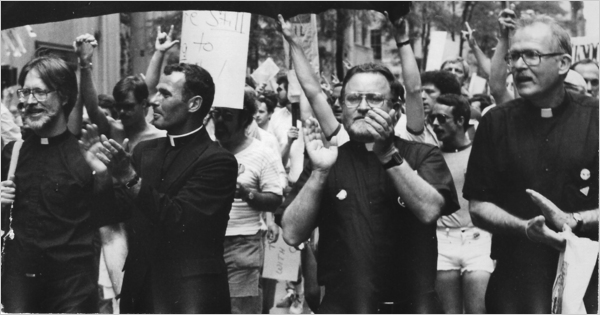
Robert Carter, right, with Dan McCarthy, left, Bernard Lynch and John McNeill at a gay pride march in the early 1980s


Thursday, 11 March 2010

Gay Marriage, in Church: Denmark Next?

Last year, Sweden approved full marriage equality, including church weddings if desired, for gay and lesbian couples. Up to now, this has been the only country where it has been possible for same sex couples to have a full religious wedding in a major denomination, and have it recognized by the state. (The other countries which recognize gay marriage, do so only for civil marriages.) However, support for full religious marriage has been building steadily, among voters and in some of the churches themselves. It now seems likely that Denmark will soon follow Sweden's example. This is not surprising - they have similar religious traditions, and similar social outlooks. Denmark was the first country in the world to approve civil unions, but has been slow to convert to full marriage. However, 1997 the bishops approved church "blessings" of civil unions, as long as the words "husband" and "wife" were omitted, so there's not a long way to go.


Now the government is considering a proposal to go the whole way, and allow full religious weddings. With almost two thirds of voters expressing support for the measure, and six out of ten bishops also ready to agree, it looks like an open goal just waiting for the final push.

Saturday, 13 February 2010

Michael B Kelly on Gay Catholics and "The Church in Four Dimensions" (Part I)

A comment to my recent post at the Open Tabernacle ,“Excluded from God’s People: the Problem with Homosexualitatis Problema” puts the question, “Why not just join the Anglican Communion?”, a frequent question whenever I write about the flaws in the official Vatican line on “homosexuality”. (This is odd, as I have never yet seen the same question put to people who question the teaching on contraception, for instance.)
My short answer was:
Why, indeed? I may disagree (strongly) with the Vatican on certain issues, but the Catholic Church is far more than just a handful of power obsessed clerics in Rome, and far more than the bizarre teachings on sexuality. I will be writing more on this shortly.
My longer answer goes along the lines clearly expressed by the Australian Catholic theologian Michael B Kelly, in an address he gave in the Melbourne City Hall, at the invitation of the Cultural Affairs Office of the city of Melbourne in January 2004. This is contained in his excellent book, “Seduced by Grace: Contemporary spirituality, Gay experience and Christian faith”, which I was reading just yesterday, and which I summarize below.

Saturday, 27 June 2009

Sharing our Stories

In Redemptive Intimacy, Dick Westley argues persuasively that revelation is constantly being unfolded for us by the Holy Spirit, and that one way that the church can interpret this continuing revelation for our times is by listening carefully to our personal experiences, as revealed by honest and frank sharing in trusting small faith communities.  When I first encountered this idea, it hit me like a bombshell, but it is one I have come to hold dear (and I have since discovered is a completely orthodox notion).

The descent of the Holy Spirit on the day of t...

It was very much in that spirit that I launched this site 6 months ago, so I was delighted earlier today to find a comment posted by Jeremiah, with some kind words, but also noting:

"...as Jim Alison teaches, we are NOT manifestations of a 'disorder'; and therefore, our insights, our experience, our unique and gay approach to the Gospel have great value.
In that gay spirit I've just launched a site for shared reflections and experience."
I have since had a look at Jeremiah's site, "Gospel for Gays",  which I found impressive.  It is technically polished, with great starting content.  I was particularly pleased to see how neatly it complements this site, with a strong emphasis on Gospel reflection, which I have long recognised as a glaring weakness on Queering the Church.   (Go ahead, take a look for yourself)

Sunday, 4 January 2009

Book Club

One of the best ways to prepare oneself for the onslaught of religion-based hostility is to read some of the very many books on the subject that have  emerged over the last thirty years or so. But with such a wealth of titles available, and the field constantly expanding, the obvious question is where to begin? To which the obvious reply is, where are you starting from?
The question matters. You need to be clear on whether you want a simple introduction, a general but comprehensive overview for laypeople, or a scholarly tome filled with notes, sources and all the necessary qualifications, ifs and buts. Are you looking for approaches rooted in scripture, or Church teaching, or both?